The road to understanding nomads’ lives, how they are affected by economic development, and their views of conservation, runs through many a tent. Lined by countless cups of tea and stories shared, by challenges and treks on horseback, and by unfamiliar notions it is a road that is unfrequented and untravelled upon. I will wear down the soles of my shoes on that road, I will get tired on that road, but I will find something along it that I cannot find elsewhere.

20 November 2006

On Censorship

“But it's normal! You can't just diffuse anything on television.” Bouba smiles and lets his outstretched fingers wiggle in the air between us, possibly in an attempt to imitate the circulation of television information, but I think he has it confused with radio waves. He has a diagonal way of grinning, only one corner of his mouth ever really changes position, the other one rests pegged to his chin like the RMB to the dollar. We've been having this conversation regularly the past few days, ever since my neighbors' cousin was on a Malian literary TV show called “En toutes lettres”.

“And why is that? I don't think it is normal at all. He should be allowed to say whatever he wants, anyone should be able to, even if it's not popular!” I stomp my foot, a little too aggressively, because the tall man with the fake gold wristwatch who just joined the conversation widened his eyes and took a step back. Momo and Moussa Djiré look at him and laugh, they have gotten used to this woman who argues louder than most men. Actually, I am not entirely sure they count me as a woman, not really. I think toubab women are essentially considered some sort of third category. They drink beer, they dress like men, they argue politics.

Tanti and Kadi are good reflections of all that I am not. Friday night, waiting for the show to come on, they both looked great. Kadi's baby was sleeping, and she had dressed for the evening in a red creation that was thin enough to double as a mosquito net. If it hadn't been so red I would've been inclined to believe that it didn't really exist.

Tanti, her pillowy curves wrapped in stretchy black velvet, nonchalantly ignored the shoulder straps that kept sliding off, revealing most of her massive breasts. She is very quiet, and if a man needs to sit she stands up without a word, and gives him her seat. She has stopped covering her upper arms now, with a shawl, like she did when I arrived. Friday night, the bright courtyard lights accentuated the pink parallel lines that break the smooth monotony of her soft dark skin.

Me, I can't help it, but my eyes gravitate towards those lines, too often. I don't know if she notices. I remember not knowing what to do with myself when she explained what had happened. It was my first week here. “My husband whipped me,” she said, without emotion. How stupid of me to ask. Did that faint smile of hers indicate a bit of embarrassment too? And if so, was she embarrassed about the incident, or about my question? Since then, no one has mentioned it. Intermittently, other women will pass by and lift up her shirt to apply iodine to the cuts, or just to look at how they are healing, but everyone else just goes about their own business.

En toutes lettres airs on Fridays, we had been told. Or Sundays, maybe. We weren't sure. But we knew we wanted to see it. If your cousin is going to be featured on national television, you want to see it with your own eyes, and you want everyone else to see, too. Especially if you attended the recording of the show, and hence might show up yourself in the audience. Being in the audience didn't actually mean that you heard much anything of what was said, though, because the audio technicians failed to deal with a nasty echo in the studio. Consequently, I was also looking forward to actually hearing Moussa talk more about his book.

Come Friday night, we had thus been sitting outside the gate the entire afternoon and evening, making and drinking tea, waiting eagerly for the show to come on. Don't get me wrong, everyone would have been sitting there even if there were no TV show, but this way the sitting had a purpose. We were waiting for something, and not just the arrival of tomorrow.

We would regularly send kids inside to check the status, to make sure we wouldn't miss the show. When Ablo came running it had already been dark for several hours. Cell phone in hand, he yelled, someone told him the show will be on any minute now. This was at twenty-one twenty-six.

Everyone sprang up from their seat. Momo picked up the tea pots and the charcoal burner, and sprinted the ten steps into the courtyard. Djiré and I grabbed the chairs, and hurried after him. The chairs are made up of plastic wires wound around a metal frame. The majority of them miss a number of wires, letting a section of your butt slide between the gaps, uncomfortably drawn towards the ground by gravity, and subsequently squeezed by the plastic.

Once in the courtyard, we put down the chairs, sat down, and continued making tea. We joked about a Bambara quasi-rhyme that two of my friends made up. “Toubabou – lakalakato, farafine – kekomani!” Tanti almost fell off her chair laughing. She ran off somewhere, and we heard her voice like an echo on the other side of the mud wall, as she repeated it to the neighbors, who also cracked up. Toubabou are white people. Lakalakato means crazy. Farafine is the equivalent of toubab, just black, and kekomani means clever, like a fox.

Tea is made in rounds, filling every new pot up with water and sugar. It's a long procedure, I believe more aimed towards killing time than producing tea. The first round is fort comme la mort, strong like death, the second one is doux comme la vie, mild like life, and the third is sucré comme l'amour, sweet like love itself.

At twenty-two twenty, the old man whose name I don't know but who has been coughing his lungs out in front of the television beckoned us. The show was on. We crowded sixteen or seventeen people in front of the box, sitting on everything from armchairs, to wooden stools, to water thermoses. We wowed when Tanti showed up on the screen, we boohed when the cameraman filmed -- twice in a row! -- the people right in front of Bouba and Mohammed. The audacity! We didn't really listen to what Moussa or the interviewer had to say. In fact, as it turned out, the most interesting part of the show was what they didn't say. Or what they said and we didn't hear.

“But he's the president! To me, there is really no point saying things like that about the president, c'est pas la peine!” Bouba leans forward for emphasis, and narrowly misses being hit in the head by a football kicked too hard, too far right. He jumps up to run after the guilty kid, giving me time to think.

On Friday, Moussa, mentioned the fact that Amadou Toumani Touré, commonly known as ATT, was currently in Washington. I'm pretty sure it was Washington. Mali is right now collecting quite the jackpot of aid from the US and the European Union, and Moussa said “All those billions he is receiving right now, when he comes back, where are they going?” (It's billions in CFA, not in many other currencies. Still a lot of money, though.) Why don't we know where the money goes? A very legitimate question, I think. In fact, Bouba thinks so too: “They are all con-artists over there. They are robbers and bandits.” But still, opinions like his and mine and Moussa's should not be aired on TV.

In the middle of En toutes lettres a man showed up in the doorway. He had very white teeth, and I didn't like his way of showing them. Tanti had her back to the door and didn't notice him until someone gestured his way. Then she squealed and jumped out of her seat, and they went outside. “That's her husband. Did you know she was married?” Mohammed explained what I had already guessed.

I asked, as discreetly as I could, where the husband lives. “Well, you see he lives in Badalabougou,” Momo hesitated a bit, and continued “She is staying here for a while now, she is resting a bit.” And that was the end of that, he turned his attention back to the television screen. Resting, that is a good euphemism, ey?

So why does Bouba think one shouldn't be allowed to badmouth the president, or even point out things the government may be doing wrong? Well, he doesn't think the average Malian will understand it. They will take it the wrong way, and it could lead to all sorts of trouble. Rebellions, social upheaval. So better not to talk about it. People won't understand, and really, it is the sort of thing you should keep within your circle of friends. Not something you should say on TV. Maybe this is also why we don't talk about Tanti's violent husband? Average people (women?) would not understand the greater picture, and might rebel, freak out, destroy the calm. It is possible that she prefers the subject not to be discussed, but maybe others invented the silence for her...

Yesterday, a woman told us about a televised meeting of merchants she had attended a few weeks back, where ATT himself took part of the discussion. Apparently, the meeting degenerated, and some of the questions angered the president to the point where he insulted the merchants present, and the Malian population in general. “He doesn't know his people,” she commented, “otherwise he would not have this reaction.” Obviously, that part of the exchange did not show up in the media.

I wonder if the journalists here don't censor themselves to a much greater extent than ATT, or other government members, would even want them to. I have been told about incidents of imprisoned journalists, but I doubt that it was for airing silly little insinuations like Moussa's... Journalists don't think ATT wants to hear what people think about him, so he doesn't hear. Consequently he can never respond to people's allegations. And when he is confronted with the realities of people's opinions, he reacts violently, because it comes as a surprise to him...

15 November 2006

This is my unapproved translation of the letter that won Moussa (Ag Assarid) 15,000 km of train travel through Europe (see my previous post). It can be found in his book, “Y'a pas d'embouteillage dans le desert !” and the passage embodies to a certain extent both what is good and what is slightly annoying about the book: his snapshots of European life and values are sometimes very sharp, and his descriptions poetic, but at times he becomes very moralizing, and makes vast generalizations – both about French and Western people, and, I think, about his own nomadic people, and their culture and values.

Papa,

Let me tell you my current feelings and impressions. I write to you from a high-speed train (TGV) that leaves Montpellier, where I study, for Paris, where I will tell Touareg stories and legends at a library. It is a blue train (the color that you love), very fast and very comfortable, that travels a thousand times faster than your big white dromedary and is as long as a caravan of one hundred camels. In less than four hours, I cross France from south to north, around 800 kilometers like between Timbuktu and Tamanrasset!

Outside the window, everything parades by at an enormous speed. Often, I cannot manage to make the distinction between the cows and the sheep. But papa, these sheep do not resemble yours: in France, they are fat and hairy and are not as free as at home. Here, the animals have the possibility to eat at will. The landscape is all green. The fields are shaped in beautiful geometric formations, a little like our saddle blankets. The climate varies along my journey: thoroughly sunny at the outset, rainy mid-way through and cold at the point of arrival.

Inside, the comfort is absolute with large reclineable seats and little tables for writing or eating. The passengers sit next to each other but they do not speak enough for my taste. Everyone has something to read or to do. It is a pity. But today's western world would do good to draw some lessons from us. And here, every person is their own TGV except that he “does not take the time to go fast,” does not take advantage of the beauty of the nature and walks right by what is essential.

Papa, you know, even with the luxury and the comfort here, I would prefer to live the nomadic life with you and the camels, the goats and the sheep, free like the wind and to go where I wish like a hirondelle on the moving sand dunes of the Sahara. But, despite this, while I wait to return, the fantastic magic of the TGV allows me to remain nomad in an incomparable manner.

I kiss you, and until we meet again, soon, under the tent.


Many of his criticisms of the west are my own (apart from a few places where our views strongly diverge), and one pearl of advice on raising children comes from how Moussa's father punished him when he wouldn't listen. “He never hit me, but he would refuse to speak to me, figuring that if I weren't listening to him, it served no good.”

It will be interesting to see how the book is received in Mali, as it could be seen as a paradoxical finger-pointing to those Malians striving for a better life, often in the image of French lifestyles they can witness on television. He admits believing, when he was younger, that having a TV would make his life better, but now he has realized that all those material goods he has access to in France are worth little, that the relationships that exist between people in the desert are what make life worth living. It is the kind of assertion that is just that much easier to make when you have all those things at your fingertips...

13 November 2006

No traffic jams in the desert

So this morning I attended the release party of Moussa Ag Assarid's book, entitled "Y'a pas d'embouteillage dans le désert !" -- There're no traffic jams in the desert.

He originally wanted to name it "Vous avez l'heure, j'ai le temps !" which is hard to translate, but essentially plays on a French distinction between the time our clocks show, and the kind of time you have on your hands. The closest I can get is "You have the time, I have time!" One of the most striking impressions French society made on Moussa was the fact that everyone always knows exactly what time it is, and what they will be doing, hour by hour, for the next year. "In the desert," he said, "we have space, and we have time."

Somehow the cousin of my very sedentary neighbors (I doubt that I will ever completely understand family relations here), he left the desert for France several years ago, and has returned intermittently, and now latest to promote his book here in Mali. It was released seven months ago, and has already been translated into Spanish, Italian, and -- slightly randomly -- Korean.

I have yet to read his book, an account that began with a letter to his father, but will let you know what I think when I am done. The beginnings are interesting enough, though: he was describing the TGV (Train a Grande Vitesse, basically French for really fast train) and its up-to-300 km/hour speeds to his father, who mainly travels by camel in the sandy Malian north. Then he heard, as by accident, about a competition that was announced in conjunction wih a TGV anniversary of some sort. It entailed writing about one's relation to the TGV, so he submitted a copy of the letter to his dad, and won!

He made a number of interesting observations, one regarding psycho-analysts and the relationship between the need for such "curers of mental illnesses" and the absence of time. "I will cure you, they say, come to me and I will cure you. But really, all they do is listen. Because no one else has the time to listen."

I am looking forward to experiencing this place, this desert, where certain material resources may be scarce, but where space, and time, abound.

On Slavery, Beans and Rhythm


demba foli, originally uploaded by Arriving at the horizon.


Written in early November.

When I stepped out of the Bamako airport, I felt as though I had never before experienced darkness. There was a lit-up walkway leading out of the airport, probably to a parking lot or a road, but the lights along it seemed to serve the only purpose of intensifying the darkness around us. Walking towards the thick night with all my luggage, I was closely surrounded by taxi drivers and families eagerly waiting for rides and loved ones, and I felt relieved that Maxim and Violetta, a French-Polish couple I'd met on the plane, had offered me a ride into town. They were staying with a friend of theirs, and there was a spare seat in the car.

I had no idea of where in town they were going, where they were staying, or -- slightly more importantly -- where I was sleeping. I had had the foresight to call ahead to a hotel to make sure I could tell a taxi driver to go to a place where a room would await me, but had left the address to said hotel in a book somewhere in some bag I wasn't sure where. In the rush of getting us all into the cab, I didn't manage to get the book out, so I sheepishly shrugged my shoulders when they asked where to let me off. After a few minutes of chatter, I managed to figure out that Moussa, Maxim's generally unintelligible friend, was telling me about a hotel near his house where I could stay, and I agreed. The rest of the ride, I stared out the window, trying to catch a glimpse of this town I had arrived in, but saw only fragments of run-down buildings, gravelly narrow streets, and slow people, walking with tomorrow as their only destination, and without being in any particular hurry to get there.

Once at the hotel, we had to figure out how to handle payment. Because we had hurried so to leave the airport, I still had a wallet full of only Euros instead of CFA, and therefore it was decided that I should leave my passport with the Chinese hotel owner as security until I had exchanged money. The Moussa character offered to take a 20 Euro bill to the bank, and return the next morning with CFAs. I had all the contact information of his European friends, knew enough about him, and was tired enough to decide to risk it. It was also at this point that I began to realize that although Moussa takes the prize as most impossible to understand, French here is overall a different breed than the French I know. “Comment tu t'appelles?” becomes “C'est quel nom?” (it's what name?), and You want some bread (Tu veux du pain?) can become “C'est le pain?” (It's the bread?) Takes some getting used to, and since I typically imitate those around me, a few months here will turn my French into a sad sad shadow of its former self.

The hotel room was air conditioned (to the point where I woke up shivering during the night), but there were indications that its previous inhabitant had put it to very enthusiastic use. I'll leave the rest to your imagination, but I have since found out that the Chinese supposedly operate a system of hotels, restaurants, and bars in Bamako whose primary purposes are not sleep, food, and drinks. Despite this, I slept OK, much thanks to the protection of a thin silk sleeping bag that my mother's (and my) friend gave me a while back. I woke up to a hot day, red soil like a carpet below my feet, ladies slowly rocking their hips past my window, balancing clay pots and plastic containers on their heads. Ah, I thought, so I am in Africa, then?

And Africa welcomed me. Adventure vibrated in the air like the heat, and the people I met radiated even more warmth than the sun. Before noon struck on this first day, I had bumped through little streets on a motorcycle, successfully dodged the police who don't allow three people on one motorcycle, and lazily enjoyed the shade underneath a roof of leaves. Before the afternoon was over, I had been installed in a tiny room on Moussa's grandmother's courtyard, eaten a falafel-sandwich lunch with an English woman who runs an NGO on pastoral issues, and been given a Malian name by my neighbors. Before I went to bed, I felt pretty overwhelmed by the slow intensity with which everything was happening, but also felt happy, and safe.

And intense it remains. In my first three days, I made it to a wedding dance, a djembe lesson, and to two different Makis, little bars where musicians' hearts beat in rhythm with their drums, where white people are a rarity, and the beer watery but cheap. Towards the end of this first wedding, the speed of the drum beat rose, and dancer Djennebou's feet were more airborne than grounded -- she was consumed by the music. As she swung her arms and legs, no one but me seemed to notice the flock of fifteen sheep that suddenly raced by the musicians, and through the circle of lookers-on. I was left to question whether it even happened.

Within the first five days, I began feeling comfortable sending little boys off with money to fetch me things from the corner store, asking the woman who always wears a shawl over her shoulders what the cuts were from (“my husband whipped me”), and vegetating in the shade of my neighbors' tree. After the first week, I had promised Djennebou to dance at the next wedding I attended, and I had begun ignoring the green-headed lizards that scramble up all walls at all times, and the old men, wearing skull caps or wool hats, no longer made me smile as widely as they did the first couple of times I walked faster than they pedaled... I am still reveling in the temporary disorientation this country has me experiencing, and in the sunsets that soak the sky in the same bright red color as the dust below, but the little kids of my street are no longer terrified of me.

Update.

Yesterday, Habib, six years old, decided that he will come home to Sweden with me, I danced at a baptism after-party, and I think I might appear on Malian television this evening.

23 October 2006

Mongolian Tradition and Gold Digging

Mongolian tradition.

Mongolia saw me off with a kind wave. I forget where I left you. I rode around the Mongolian countryside a fair amount more, well-equipped with a traditional deel, the calf-length robe that has kept Mongolians warm in double-digit negative temperatures for centuries.

There were brilliant moments. I give you as an example, this one evening out in Biluite valley, where a Swedish woman named Anneli lives. I met her mother on the Trans-Siberian railway last year, and decide to visit Anneli. She lives in three-wall ger, in a remote valley, with her husband and a handful of cows who had generally given up on giving milk for the winter by the time I got there. Gers come in different flavors, mostly depending on how many lattice-walls they are made up of: three walls is as small as they get. Four walls is common, and five is big. Anneli got three calves this summer, and two foals. The foals were eaten by the wolf, and two of the calves also met their destiny in the form of sharp teeth. Suffice to say it's a hard life out there.

Ellen, another Watson fellow, was traveling with me for a few days, and we hitchhiked out to this valley, where I had left my horses a week or two earlier. Her Watson project deals with how life experience influences folk music in the circumpolar north, so we listened greedily to the songs that are generously dished out by pretty much every driver in the country. Mongolians sing a lot, and they sing well. In any given vehicle filled with any given fifteen (or seventeen, or twenty-three) people, thirteen (or fifteen, or twenty-one) of them will have breathtaking singing voices, and the two that don't are usually the foreigners. You sing when you are driving somewhere, you sing when you are riding across the steppe, and you sing during dark evenings.

One such dark evening in Biluite valley we spent singing. Upon arriving, I had given Bold, Anneli's husband, a bottle of vodka, as thanks for watering and taking care of my horses for a week. He stuck it inside his deel, and carried it around until bedtime. When we, the women, were about ready to go to bed, Bold was sitting at the altar part of the ger (the northern part of a ger is sacred; it is where you burn a bit of incense, and wax candles, and have pictures of your old mom and the Dalai Lama) and suddenly a half-empty vodka bottle appeared in front of him. And by appeared, I mean that he drank half of it in less time than it took us to realize he had even sat down.

He then proceeded to give us women a night cap in the form of “zuun gram” -- 100 grams of vodka. Anneli then suggested that he sing for Ellen, since he had drunk the vodka we gave him. But in Mongolia, you don't just sing, it ain't that easy, you also have to drink airag, fermented mare's milk. So we drank airag. And we sang. Anneli filled up a 4-liter metal jug, and from the jugs you pour half-liter bowls, which whoever is singing holds on to, and drinks after the end of the song. And Bold, being the only Mongolian in the vicinity, made up tons of rules that benefited him, under the auspices of “Mongolian tradition.”

-- Why does the youngest person have to drink more?

-- Mongolian tradition.

-- Why can't we sing together if the song is in English?

-- Mongolian tradition.

And so on.

Luckily airag is more along the lines of beer than liquor as far as alcohol content goes, but the next morning, Anneli counted that we had consumed about thirteen liters of horse's milk. That's a lot of milk, whether it is fermented or not. When we were ready to go to bed for the second time, Anneli uttered the best-ever end-of-an-evening comment. As we reluctantly ventured outside into the cold to go to the 'bathroom,' she said “Damn, I am glad that I only have one cow to milk in the morning.” It made my day.

Gold diggers.

A few more things are worth noting about Biluite valley. It is part of Khangai Nuruu National Park, some 150 km from Kharkhorin, Chinggis Khan's ancient capital. It is a valley whose families were asked to relocate for the summer. Find somewhere else to stay. Every family received a little paper note, explaining that the valley is overgrazed, and that they need to move elsewhere. Most of them used it as toilet paper, or to light the stove in the morning.

Grazing is hard on the valley, that is true, with too many households and too many animals residing there. For families whose single biggest expense in a year is transportation between seasonal dwellings, the question remains: “Who is going to pay the extra costs of moving further away?” The government collects taxes, I was told, but contributes very little to people's lives. Children need to go to school, families need water, but they do not help pay for boarding in the village, they do not help maintain wells. And it was to no one's surprise when, a few weeks after the little paper slips demanding relocation were distributed, big machinery rolled over the hills into Biluite with government permission to prospect for gold.

When you wake up in a ger that is below freezing in the morning, you understand people's attitudes towards regulations that prevent wood-cutting for fuel – the attitudes are about as negative as the temperature. If you in addition have little or no reason to believe that the government's pretty words about environmental protection are anything but empty public relations stunts, you might as well use their fancy notes to wipe your behind, right?

After I left Biluite came the challenge of selling the horses in late September (advice: if you ever have to sell a horse in Mongolia, don't do it in the period September – November). All the potential customers wanted horse meat, but I thought my horses were too good horses to become sausage, so I kept looking. At this point I had about two days left before my flight was leaving, and I was still in the countryside. Finally, a couple I had gotten to know quite well bought them, with a lovely red vest that she had made as partial payment. Soft hearts may not make a lot of money, but I think they are happier in the end.

22 October 2006

Immigration statistics and Expensive Apartments


On the right side: Fully expensive furnished 2-room apartment...

Any takers? (UB Post, August)

On the left: immigration statistics. If they weren't so incredibly muddled, you might find some interesting facts there... Like, the increase of foreigners enterring Mongolia in the first half of 2006 increased by 60.8% compared to the same period in 2005. And 0.1% of those foreigners "had Middle East region citizenship."

Old News - Mongolia Solves Nuclear Crisis?


I guess Mongolia failed in this task... "to resolve the Korean peninsula nuclear weapons issue peacefully."

Mongol Messenger, September 13

"On September 5 at Parliament House, Prime Minister M. Enkhbold met Korea's Defense Minister Hwang Kyu Shik, who invited Mongolia to help with negotiations to resolve the Korean peninsula nuclear weapons issue peacefully."
I am glad Mongolia is becoming an important player in the field of world politics... Er... Anyway, on October 12, the UB Post stated that the The Mongolian Government expressed “deep regret” in reaction to the news that the Democratic People’s Republic of Korea “conducted a nuclear test on October 9, 2006 in spite of the will and demands of the international community.”

01 October 2006

Nasty, Brutish, and Short... Making peace with UB


Balcony IV, originally uploaded by Arriving at the horizon.

Taking pictures of little beautiful things hiding in the pollution is one way I try to remain on speaking terms with UB. Above is a picture of the plastic wall of my balcony.

It seems appropriate that I, on my last day in Mongolia -- unavoidably spent in Ulaan Baatar, the city I love to hate -- try to reconcile our differences, and make peace; I should leave in peace.

No matter how much I dislike this city -- it's rude, it colors my lungs black, and it leaves a taste in my mouth like too many beers the night before -- there are moments when I feel I judge it too harshly.

Peace Avenue is far from peaceful. It is a place of pollution and loud cars, where "nasty, brutish, and short" seems like a very accurate description of the life of man. But sometimes, you can gaze west along it, through dryer-fuzz-colored air, and rest your eyes on a mountain at the horizon. If your timing is right, just before dusk, the mountain is on fire, bathing in the bright pink rays of the sinking sun.

Indeed, any street that continues long enough in any given direction will reveal flowing hills at its end, reminding you that Mongolia is not very far away, with its open spaces, endless horizon, and starry sky.

The colorless, dusty asphalt sometimes drives me nuts, but if you watch closely where you step, you can sometimes spot the imprint of a horse that stepped in that very same place, many years removed in time.

Somehow it warms my heart a tiny bit to notice those little departures from UB's right-angled industrial city facade.

Monkzul and Mundo Uno

I love this portrait of Monkzul (and I will post more photos of her soon), and was very happy to discover that while I was riding around in the countryside (and taking more photos of her and her cousin), the group Mundo Uno displayed her on their front page...

Mundo Uno is a group that was formed during the most violent days of this summer's Middle East crisis. It grew very rapidly, indicating a wide-spread wish among people to stop the fighting, and the culture of war in general.

When I heard about the conflict on BBC World, I remember thinking how unreal it seemed. Indeed, terror threats and deadly shootings and suicide bombings feel more remote than the most far-away parts of Mongolia, very abstract and almost fictitious from this peaceful place.

As Mundo Uno state on their Flickr page, the group exists in order "to keep people united, to develop a culture of peace, share some knowledge, to support actions for peace" -- worthy goals, for sure.

Even though the first thing someone told me when I began thinking of coming to Mongolia was "Emilia, you're going to have to buy a gun" it does appear to me as an ideal place to share images from, in the spirit of peace.

The Art of Waiting

Mongolians are highly skilled in the fine Art of Waiting, much of their lives are spent waiting. The idea that time is money has little meaning here; no one is in a hurry anywhere, and the implications for an economy are rather interesting.

I've spent quite a lot of time this summer honing my waiting skills, but I still have a long way to go. Sometimes I'll just buy a bag of pine nuts and go sit on a bench eating them, waiting for nothing in particular, cracking the shells between my teeth, getting the little nut out, spitting the remaining shell on the ground. I'll watch it bounce on the pavement a couple of times, and move on to the next nut. I gaze around, looking at no one person or thing, just waiting.

People here can spend entire days waiting. Waiting for a vehicle to leave, waiting for food to be made, waiting for the sun to move across the sky. I have hired motorcycles to take me places for little more than the cost of the gasoline required to reach the destination. I guess that is what happend when the opportunity cost of a person's time is not just tiny, but literally zero.

Sometimes other things, like superstition, play into the waiting. Like when you are waiting for a vehicle. It's bad luck to ask how long it will take to get somewhere, and if a car breaks down, you don't ask what is wrong or how long it will take to fix it, because that too is bad luck. You just lean back and wait. Moxie and I had a textbook experience coming back from Kharkhorin: the micro broke down, and for hours and hours, in the middle of night, everyone in it sat and dozed off. Stared out the window. Snored. The driver fiddled and tweaked and took out the scotch tape, and finally also just sat down and waited for the battery to recharge itself.

I also think it would make a great Watson project (lately I have been spitting out Watson projects like it was my job) - the anthropology of cultures where waiting is a prominent feature of daily life, or perhaps the implications of such cultural phenomena on a labor market. If the opportunity cost of time is zero, and labor is abundant, what happens to wages?

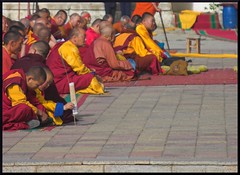
I used to think that I was quite brilliant at procrastinating, but have realized now that I am but a novice, with much to learn about the noble art of waiting. The munklings in the picture are young, but already quite skilled.

flickr.com/modern_nomad